

2 min read
AI Transformation Is a People Transformation: 5 Takeaways from Our Webinar
John Just : Oct 28, 2026, 10:16:23 PM
Hand every person in your company the best AI tools available tomorrow morning. Are you AI-transformed?
Of course not. The technology changes overnight. Your people don't.
That was the starting point for our webinar, AI Transformation Is a People Transformation, hosted by RemoteBridge CEO Dr. John N. Just. Over 45 minutes, we looked at the three transformations happening at once inside every organization adopting AI:
- Technology transformation: what AI tools and agents can do.
- Workflow transformation: how work actually gets accomplished.
- Human transformation: how people behave, communicate, decide, and adapt.
Most companies pour their energy into the first. Some are working on the second. The third usually gets filed under "training," and that's where transformations stall. Here are five takeaways from the session.
1. AI value is mostly a people problem
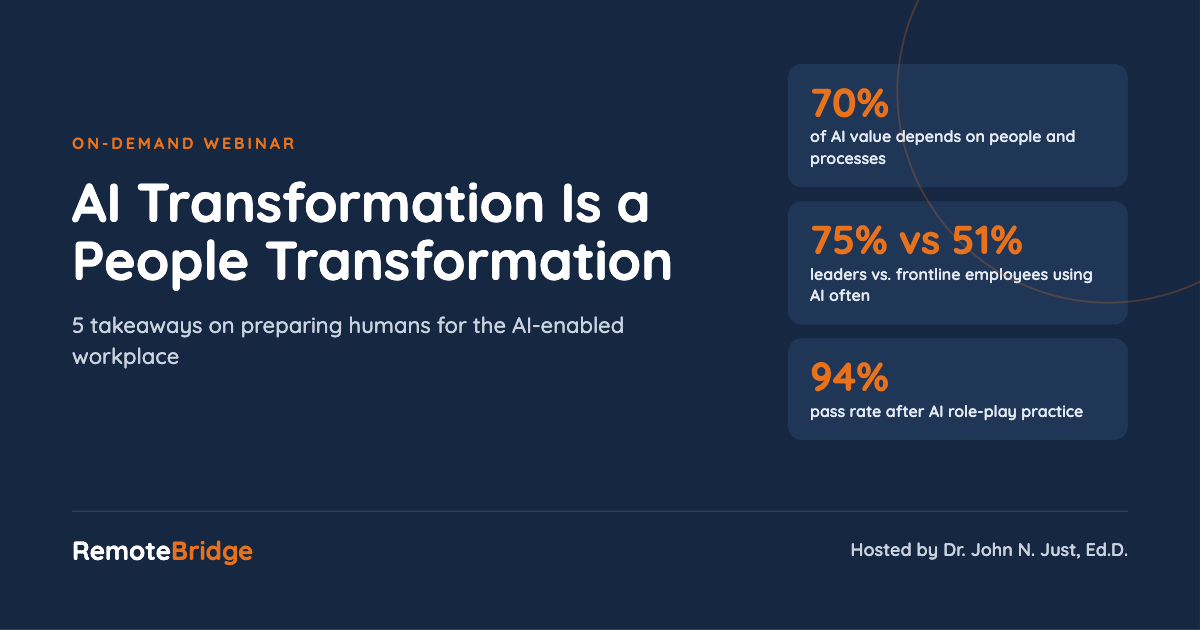
The biggest share of AI's value doesn't come from the model. Roughly 70% depends on people and processes, about 20% on technology and data, and only about 10% on the algorithms themselves. If your AI roadmap is mostly a list of tools, you're planning for the smallest slice of the outcome.
2. There's an adoption gap between leaders and the front line
Leaders are using AI far more than the people doing the frontline work: about 75% of leaders use it frequently, compared with 51% of frontline employees. And only around a third of employees say they've been properly trained. When the people closest to customers are the least prepared, the customer experience is where the gap shows up.
3. Frontline innovation drives real results
When frontline teams are equipped and trusted to improve how work gets done, the results are measurable. In one example from the session, frontline-driven innovation improved on-time delivery by 12%, pushed roadmap completion close to 90%, and helped launch a new product line. The people doing the work often know best where AI fits and where it doesn't.
4. Practice is what changes behavior
AI creates new, uncomfortable conversations. A manager telling an employee that AI will handle part of their job. A salesperson hearing "I already got this from ChatGPT." A support rep deciding whether to trust or override an AI-generated answer. These aren't software-training problems. They're human interaction problems, and people get better at them the same way they get better at anything: practice.
With AI role-play, teams in our program completed 128 practice sessions with a 94% pass rate and an 84% median score. Practice turns a policy document into a skill people can actually use.
5. Start with one workflow, not the whole org
The most practical advice from the session was to start small and human:
- Pick one workflow where AI can make a visible difference.
- Redesign the roles and processes around it, not just the tools.
- Support your managers, who carry most of the change conversations.
- Celebrate learners publicly so experimentation feels safe and rewarded.
Watch the full webinar
The scariest AI transformation isn't one where the technology fails. It's one where the technology works, but your people don't change with it.
The full recording covers all three transformations, the data behind them, and examples of how teams are preparing people for an AI-enabled workplace.
Watch AI Transformation Is a People Transformation on demand →