.png?width=1300&height=397&name=Logo%20Lockup%20Orange%20(1).png "Logo Lockup Orange (1)")
.png?width=720&height=220&name=Logo%20Lockup%20Orange%20(1).png "Logo Lockup Orange (1)")
3 min read
Remote Management Isn't In-Person Management with a Webcam
John Just : Sep 22, 2026, 11:06:13 AM
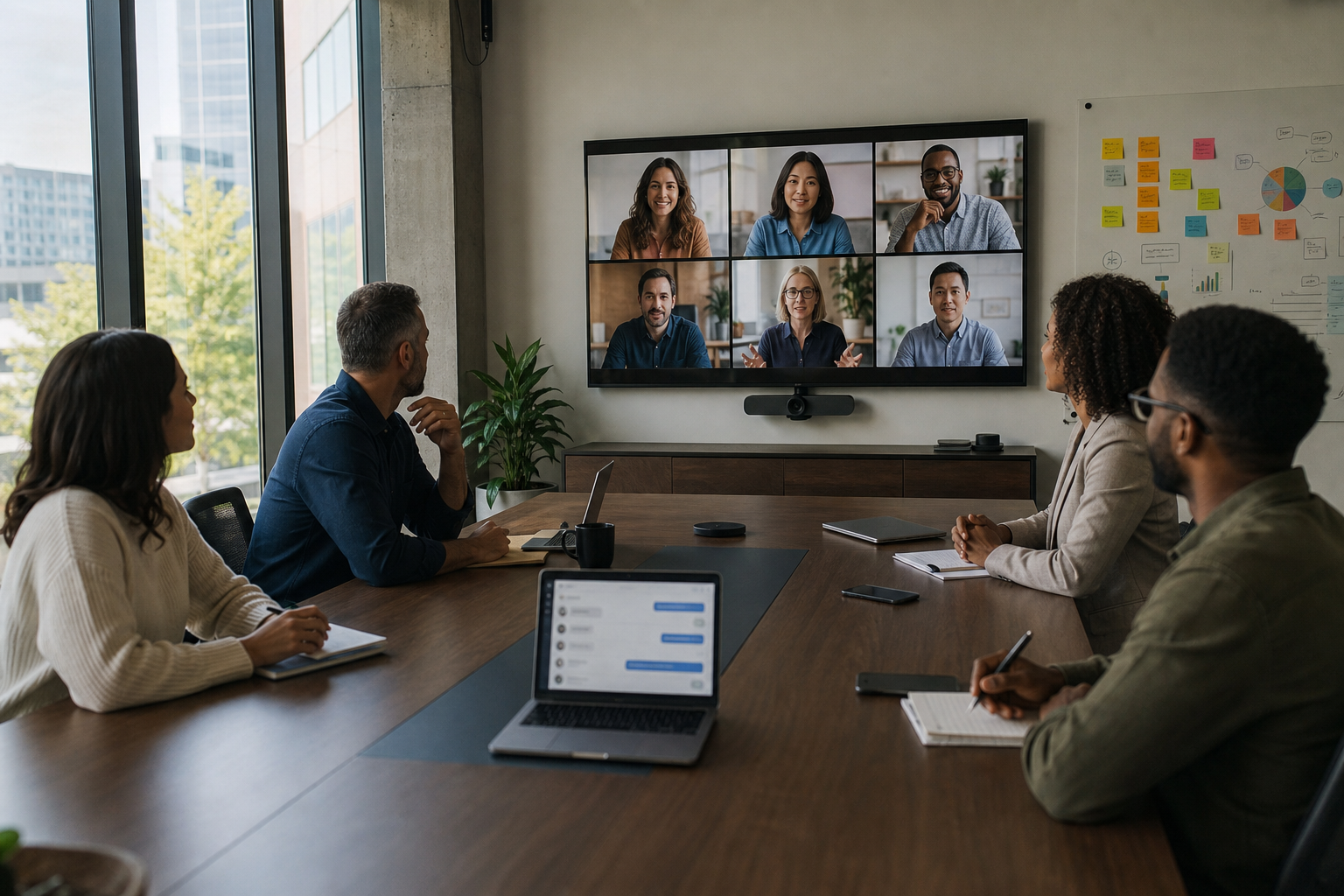
I've been managing remote teams for fifteen years. Long before "work from home" became a pandemic-era headline, I was hiring staff who never set foot in a building, running a virtual team where my entire staff lived in different states, and later leading a 120-person content team at KnowBe4 that was spread across time zones. COVID didn't invent remote work. It just made the rest of the corporate world catch up to something a lot of us had already been doing for years.
Here's what that decade and a half taught me: managing a remote team is not the same job as managing an in-person team that happens to be on Zoom. It looks similar from the org chart. It is not similar in practice.
When you manage in person, you get information for free. You see who's disengaged in a meeting before they say a word. You catch a struggling employee in the hallway and ask how they're really doing. You build trust through a hundred small, unplanned moments, a shared coffee, a joke before a meeting starts, a walk to the parking lot. None of that happens by accident when your team is remote. Every bit of trust, every read on morale, every early warning sign of a problem has to be built deliberately, because the environment won't hand it to you.
That's the part most organizations got wrong when they went remote overnight in 2020. They gave managers laptops, Slack, and Zoom licenses, and assumed leadership would translate. It didn't. Managers kept running remote teams with in-person instincts, and a lot of them are still doing it today, even in hybrid setups where half the room is physically present and half is a grid of faces on a screen.
This Is an L&D Problem, Not Just an IT Problem
If you're in learning and development, or you're leading an organization that's building out its leadership pipeline, this is worth sitting with for a minute. We spent decades building new-leader programs, executive leadership tracks, and management training around an assumption: that leadership happens face to face, and that the skills worth teaching are the ones that show up in a conference room.
That assumption is outdated. Reading tone in a text-only Slack message is a different skill than reading tone in a face-to-face conversation. Running a meeting where half your audience is one unmuted button away from checking out is a different skill than holding a room. Coaching an employee whose performance is slipping, when your only signal is a slower response time and a camera that's stayed off for three weeks, is a different skill than catching it at their desk.
These aren't smaller versions of in-person skills. They're distinct competencies. And if our new-leader programs, executive leadership programs, and management curricula don't name them and build them on purpose, we're sending leaders into distributed teams with a skill set built for a room that doesn't exist anymore.
I don't think this is all bad news, by the way. Distributed teams force better documentation. They widen the talent pool past whoever happens to live near your office. They push leaders toward more intentional, more equitable communication because they can't rely on who happened to be standing nearby. The organizations that build real remote and hybrid leadership skill get real upside from it. The ones that don't just keep wondering why engagement scores are flat and turnover is up.
What We're Building at RemoteBridge
This is exactly why we built RemoteBridge. Leaders don't get better at hard conversations by reading a slide deck about them. They get better by practicing, getting it wrong in a low-stakes setting, and trying again. Our platform, RevCore, lets leaders and managers practice realistic scenarios against AI-driven characters and get instant feedback on skills like empathy, clarity, and how they actually handle the moment, not just how they think they'd handle it.
We're announcing five new leadership simulations, available to demo and trial starting now, with more on the way:
- Difficult Conversations with Remote and Hybrid Workers: practicing how to deliver hard feedback or address a performance concern with someone you can't read across a table. This is a simulation to build the interaction skill in a safe setting, not a stand-in for the real conversation itself.
- Onboarding a New Hybrid Hire: building trust and connection with someone who may go weeks without meeting a teammate in person.
- Leading an Engaged Virtual Meeting: keeping a distributed team present and participating instead of quietly multitasking off camera.
- Coaching Through Performance Decline at a Distance: recognizing the early, easy-to-miss signals of a struggling employee before it becomes a formal issue.
- Managing Time Zone and Communication Friction: working through the misunderstandings that build up when a team relies on async messages instead of hallway conversations.
If you lead learning and development, or you're responsible for how your organization builds its next generation of leaders, I'd invite you to try these out. Remote and hybrid management isn't going away, and the leaders who get real practice at it now are going to be the ones your best people want to work for.
Join us for an upcoming webinar on AI Transformation
On Wednesday, October 28 at 12 PM EST, I'll be hosting an upcoming webinar, AI Transformation Is a People Transformation: Preparing Humans for the AI-Enabled Workplace.
We'll dig deeper into the three transformations happening simultaneously — technology, workflow, and human — and discuss what organizations can do to prepare people for what comes next.
I hope you'll join the conversation.