.png?width=1300&height=397&name=Logo%20Lockup%20Orange%20(1).png "Logo Lockup Orange (1)")
.png?width=720&height=220&name=Logo%20Lockup%20Orange%20(1).png "Logo Lockup Orange (1)")
4 min read

People ask us some version of the same question at almost every demo of our AI role-play training: why don't your characters look more real? The AI behind them is modern. The voices are natural. So why do Derrick, Sarah and the rest of our cast look like they stepped out of a well-made game instead of a Zoom call?
Short answer: we did it on purpose. The longer answer is a 56-year-old idea from robotics called the uncanny valley, and a growing pile of research suggesting it matters a lot more for training than most people realize. Alex Sheshunoff sent me a note on this recently that got me digging, so here is what the evidence actually says, and why it shaped the way we build.
What Is the Uncanny Valley?
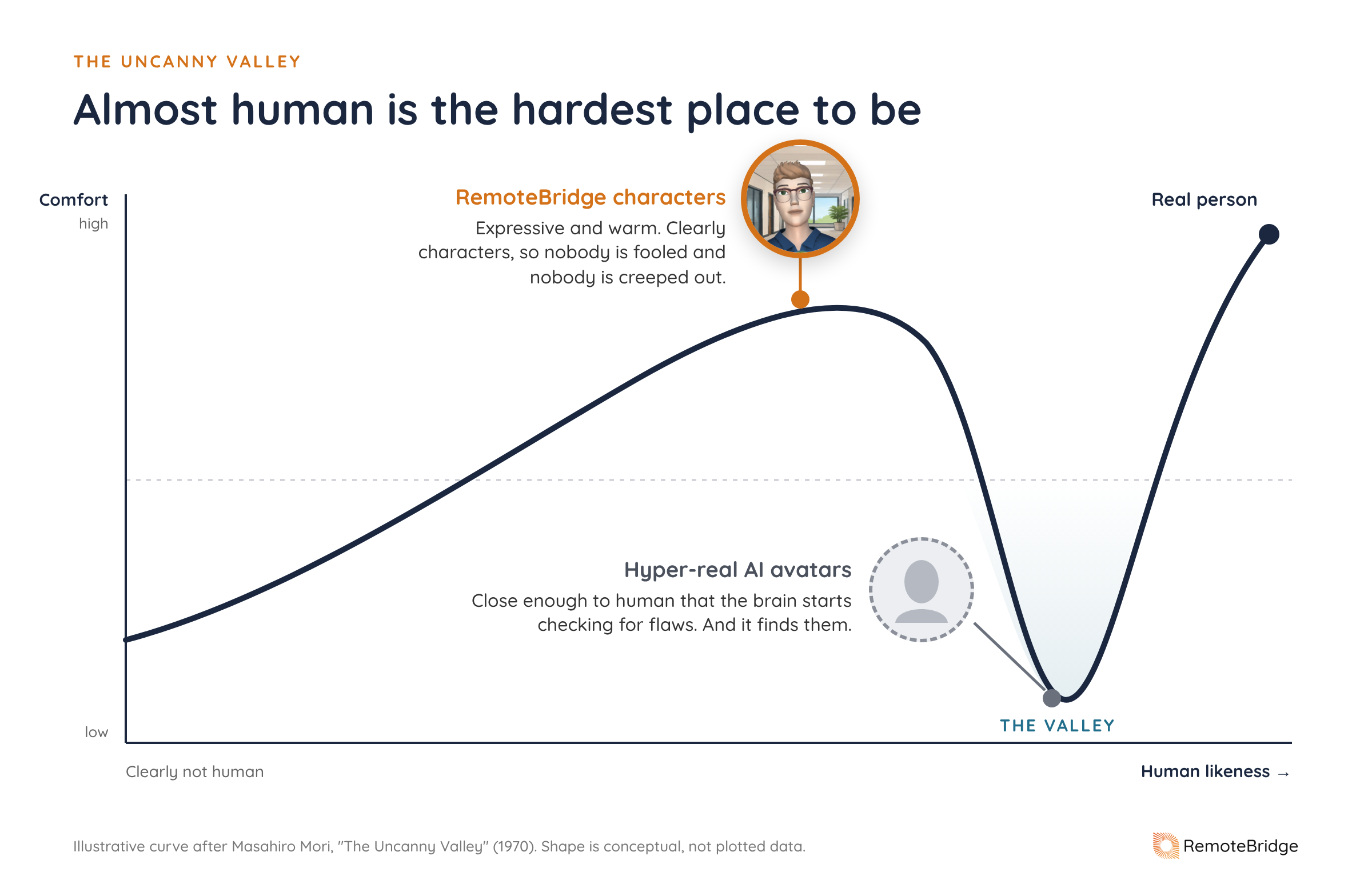
In 1970, Japanese roboticist Masahiro Mori proposed something that sounded odd at the time. As a robot or character looks more human, people feel more comfortable with it. Up to a point. When it gets almost human, but not quite, comfort doesn't level off. It drops off a cliff. Only when something becomes indistinguishable from a real person does comfort climb back up. Mori called that dip bukimi no tani, which became "the uncanny valley" in English.
[GRAPHIC 1: Uncanny Valley Curve. Alt text: "Illustrative uncanny valley curve showing stylized RemoteBridge characters near the comfort peak and hyper-real AI avatars in the valley."]
You have probably felt this yourself. A cartoon character can make you laugh or even tear up. A wax figure that is 95% right can make you want to leave the room.
Is It Real, or Just a Good Story?
For decades the uncanny valley was more theory than evidence. That has changed. A few studies stand out:
- Robot faces, rated by real people. Maya Mathur and David Reichling had participants rate 80 real-world robot faces, from clearly mechanical to nearly human (Cognition, 2016). Likability rose with human likeness, dropped sharply near the human end, then recovered. They also ran a trust game where people decided how much money to hand a robot. People were more reluctant to trust robots in the valley, though that effect was smaller and more nuanced than the likability drop.
- Flaws hurt more on realistic faces. Jun'ichiro Seyama and Ruth Nagayama found that the same small abnormality, like slightly enlarged eyes, felt far more unpleasant on a realistic face than on an obviously artificial one (Presence, 2007). The more real a face looks, the less forgiving we become.
- Your immune system notices. In a 2025 study from the University of Hamburg, people interacted with virtual humans in VR. Avatars with uncanny features triggered a measurable immune response in saliva after about six minutes of interaction, similar to the response to avatars that looked sick (Scientific Reports, 2025).
That last one stopped me. Six minutes is roughly the length of one of our role-plays.
Why It Happens
Researchers still debate the cause, and I won't pretend it is settled. Two explanations come up most often.
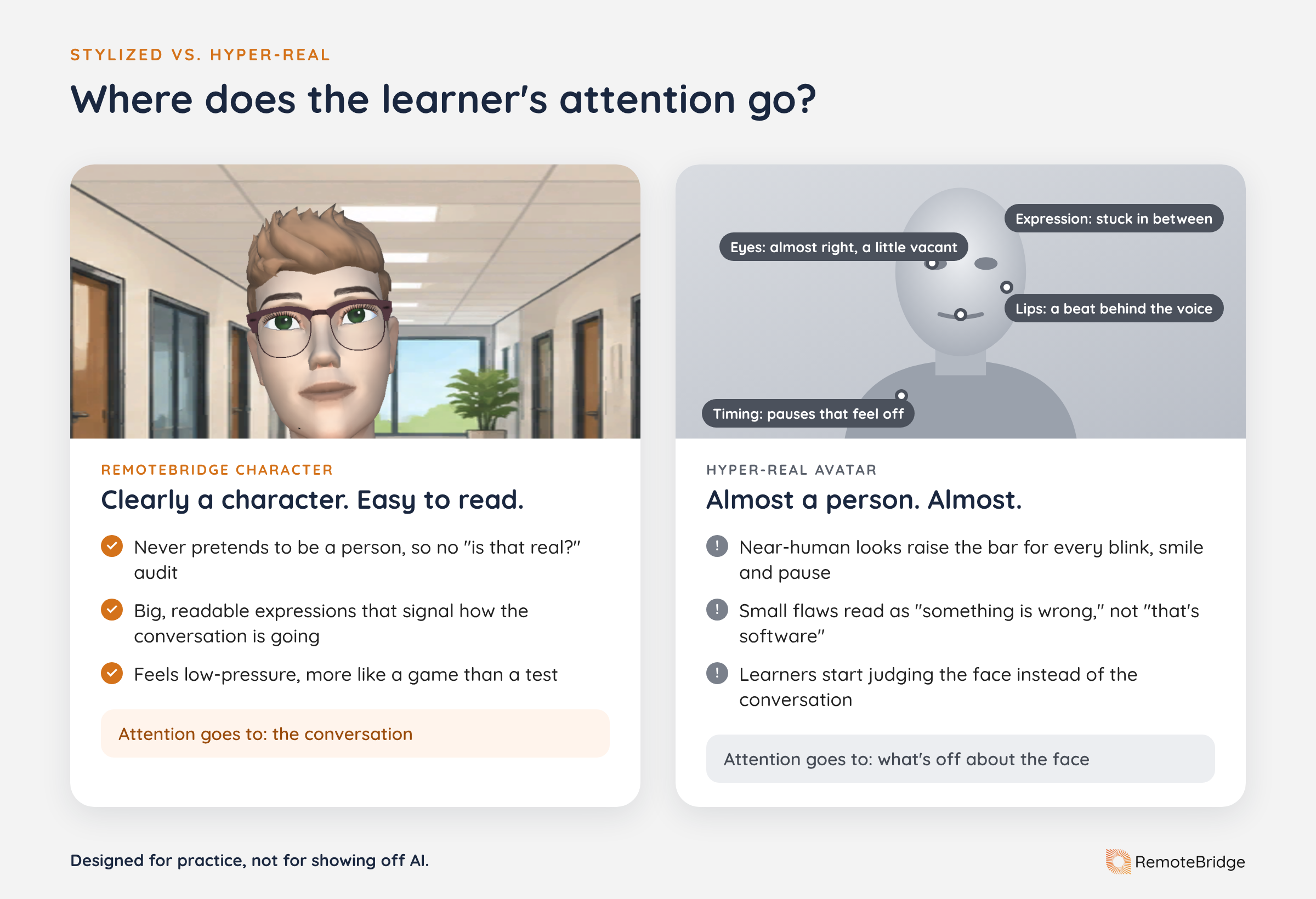
Expectation mismatch. When something looks almost human, your brain switches into "this is a person" mode and starts holding it to human standards. Every blink, glance and pause gets checked against a lifetime of real conversations. Small misses, like eyes that are a little vacant or lips a beat behind the voice, register as "something is wrong" instead of "that's software."
Pathogen avoidance. The other theory is older and more primal. Faces that look subtly off may tap the same instincts that once helped humans steer clear of illness. The Hamburg immune study is the first direct evidence for that idea, and it is worth taking seriously.
One honest caveat. Mori predicted that motion would make the valley deeper. Research since then is mixed. A 2014 study in Cognition found that good, natural motion actually made near-human characters more acceptable. The problem isn't movement itself. It is imperfect movement on a face that is promising perfection. And real-time AI avatars, generating speech, lip-sync and expressions on the fly, are exactly where those tiny timing errors creep in.
What People Feel in the Valley
The reactions people describe are consistent: a vague unease, a sense that something is "off," a creepiness they can't quite name, and a quiet suspicion that the character is faking its humanity. None of that is helpful when the goal is to get someone to practice a hard conversation.
Why This Matters for Practice
Here is the part I care about as a learning person. Practice only works when two things are true. The learner has to feel safe enough to try, stumble and try again. And their attention has to be on the skill, not on the technology delivering it.
A hyper-real avatar puts both at risk. If a frontline employee spends the first two minutes of a de-escalation scenario wondering why the customer's eyes look strange, that is two minutes they are not spending on tone, empathy or what to say next. If a new manager feels uneasy about the "person" across from them, they are less likely to experiment with a feedback conversation they have never had before. Attention is the scarcest resource in any training program. Uncanny faces spend it on the wrong thing.
[GRAPHIC 2: Stylized vs. Hyper-Real. Alt text: "Side-by-side comparison of a stylized RemoteBridge character, where attention goes to the conversation, and a hyper-real avatar, where attention goes to flaws in the face."]
Designed for Practice, Not for Showing Off AI
So we went the other way. Our characters are clearly characters. They have expressive faces you can read at a glance, so a learner can tell when a customer is getting more frustrated or when a prospect is warming up. They never pretend to be a real person, so nobody's brain starts running the "is that real?" audit. The experience feels closer to a game than a test, which is exactly the low-pressure space where people are willing to try something new.
This isn't an argument that realism is always bad. Some realistic characters are built extremely well, and the research has real nuance. But for training, the bar is simple: does the character help the learner focus on the conversation? Stylized characters clear that bar every time. Almost-real ones are a gamble.
The AI is the engine. Your people's performance is the product. We would rather you remember what you practiced than how impressive the avatar looked.
Join us for an upcoming webinar on AI Transformation
On Wednesday, October 28 at 12 PM EST, I'll be hosting AI Transformation Is a People Transformation: Preparing Humans for the AI-Enabled Workplace. We'll talk about the technology, workflow and human sides of AI at work, including how to design AI experiences people actually want to use.
I hope you'll join the conversation. Click here to register.
Sources
- Mori, M. (1970). The uncanny valley. Energy, 7(4). English translation by MacDorman & Kageki, IEEE Robotics & Automation Magazine (2012).
- Mathur, M. B., & Reichling, D. B. (2016). Navigating a social world with robot partners: A quantitative cartography of the Uncanny Valley. Cognition, 146.
- Seyama, J., & Nagayama, R. S. (2007). The uncanny valley: Effect of realism on the impression of artificial human faces. Presence, 16(4).
- Piwek, L., McKay, L. S., & Pollick, F. E. (2014). Empirical evaluation of the uncanny valley hypothesis fails to confirm the predicted effect of motion. Cognition, 130(3).
- University of Hamburg (2025). Virtual humans in the uncanny valley activate the immune system. Scientific Reports.